About Us > PhysioNews and Other News > Honoring a Builder of Institutions: The Remarkable Journey of Professor Emmanuel Babatunde John
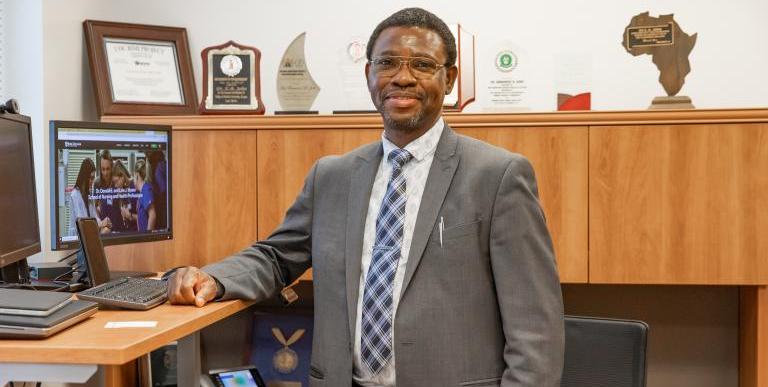
I would like to extend my heartfelt congratulations to Professor Emmanuel Babatunde John on his nomination by the Africa Region of World Physiotherapy as one of the 75 Noteworthy Physiotherapists in the World. This recognition is profoundly deserved. The nomination report beautifully chronicles a lifetime of service achievements that are, in truth, unsurpassed by any physical therapist anywhere in the world. I have often wondered where he finds the energy, discipline, and conviction to undertake the bridge‑building, humanitarian, and institution‑shaping work that our profession so desperately needs.
One of the best professional decisions I made early in my academic career was to return to Nigeria in 1986 after completing my doctorate and spending two years teaching and conducting research as an Assistant Professor of Physical Therapy at Russell Sage College in Troy, New York. At the time, many colleagues considered the decision "unwise and career‑ending," given the poor research infrastructure and draconian conditions in Nigerian universities. Yet I returned with the hope of contributing my quota to the development of the physical therapy profession in Nigeria. At that time, there were only two faculty members with doctoral degrees across the four universities offering physical therapy—Professor Nwuga and Dr. Owoeye. The four universities offering physical therapy in 1986 were the University of Ibadan, the College of Medicine, the University of Lagos (CMUL), and Obafemi Awolowo University (OAU), and the University of Nigeria, Nsukka. I was determined that my presence in Nigeria would bring a breath of fresh air and raise the aspirations of students and young physical therapists who saw limited possibilities for themselves.
Forty years later, I look back with satisfaction on the impact I made in the Nigerian academy, particularly through my appointment as the coordinator of the first graduate program in physiotherapy at OAU, Ile‑Ife. This role positioned me to mentor many students who later became the "movers and shakers" of the physical therapy profession in hospitals, academia, the military, and public service across Nigeria and beyond. It was during my sojourn in Nigeria between 1986 and 1991 that my path first crossed that of Professor Emmanuel John—although our recollections differ slightly.
According to Emmanuel's account, which he eloquently shared in my autobiography Echoes of My Life as a Physical Therapist, we met in 1991 at the College of Medicine, University of Lagos (CMUL), where I served as External Examiner for the 300‑level practical examinations in Electrotherapy, Exercise Therapy, Kinesiology, and Massage. He was a patient actor for one of the students. He recalled the mixture of fear and trepidation among the students at the sight of the "dreaded" external examiner they had heard so much about. Contrary to the reputation that preceded me, he observed my graciousness and simplicity as I reassured the students that I was not there to fail them but to assess what they knew. He later wrote that CMUL students "envied our colleagues at OAU for having such a great lecturer as Dr. (now) Professor Balogun, but did not envy them for being subjected to such high levels of academic rigor." He concluded by saying he had since migrated to the United States and adopted me as one of his mentors—an honor I do not take lightly.
My own recollection places our first meaningful contact in 2002, following his admission to the PhD program in Rehabilitation Science at the University of Kansas Medical Center. I received an email from an unknown physiotherapist in Kano requesting assistance with paying the TOEFL registration fee required before his arrival in the United States. I was delighted for him and paid the fee immediately. It turned out to be one of the wisest investments I ever made, for Emmanuel has repaid me tenfold through his service, loyalty, and extraordinary professional accomplishments.
Emmanuel is a visionary leader, a technologically gifted educator, and a humble, generous human being. I would like to recall three occasions when he came to my rescue and offered his expertise entirely pro bono.
In 2016, I hired a supposed "expert" from Asia to design a Wikipedia page for me. I paid his exorbitant fees, only to discover he was a banned scam artist whose work was rejected outright. Disappointed, I abandoned the project. A week later, Emmanuel called, and I shared the story. He laughed heartily—not at my misfortune, but at the irony—and said, "Prof, you could have asked me before making such a decision." I replied that I knew he designed websites, but did not know he created content for Wikipedia. Within two weeks, he produced a page that was accepted immediately. I was reminded of the Yoruba adage: What you are going to look for in Sokoto (the Seat of the Caliphate in Northwestern Nigeria) is already in your Sokoto (pocket). I had sought help from a stranger far away in Asia when the expert I needed was already close to me in Chicago.
After the publication of my memoir in 2017, Emmanuel approached me at the IANPT conference in Baltimore to congratulate me. I expressed my frustration with the Nigerian publisher's poor production quality. He informed me that he had just launched a publishing outfit and offered to republish the second edition. I agreed without hesitation. Within six months, he completed the project and published the revised edition on Amazon in 2018 for a global audience.
In 2013, after serving as Dean of the College of Health Sciences at Chicago State University for 13 years, I returned to the classroom to reconnect with my passion for teaching and research. During my second year back, I attempted to teach my biostatistics class online after completing training in remote instruction. I struggled with using Zoom to display my calculations. Instead of contacting my university's IT office, I called Emmanuel. He immediately recommended the appropriate interface device, explained how to use it, and sent me additional resources that proved invaluable.
As I reflect on these experiences, I am reminded that mentorship is a two‑way gift. What begins as guidance from teacher to student can, in rare and remarkable cases, evolve into a lifelong exchange of wisdom, generosity, and shared purpose. Emmanuel is one of those rare cases. He has not only honored the mentorship he received—he has elevated, expanded, and transformed it into a legacy of service spanning continents.
Witnessing a former student rise to become an institution builder, a steward of professional identity, and a global ambassador for physical therapy is one of the greatest privileges of my career. Emmanuel embodies the very best of what our profession can produce: intellect without arrogance, leadership without self‑interest, and service without boundaries.
Today, as he stands among the nominees for one of the 75 Noteworthy Physiotherapists in the World, I do not merely see a student being honored. I see a colleague, a partner in progress, and a man whose life's work has strengthened the foundations of physical therapy for generations to come.
It is with profound pride and deep personal satisfaction that I affirm:
Professor Emmanuel Babatunde John is not only deserving of this global recognition—he is the very embodiment of what such an honor was created to celebrate.
Joseph A. Balogun, PT, PhD, FACSM, FNSP, FAS, FIMC, FRSPH, FCDP
Emeritus Professor, 2025; Retired, 2022, Distinguished University Professor, 2008,
Dean, College of Health Sciences, 1999–2013,
Chicago State University
9501 South King Drive
Chicago, IL 60628
https://en.wikipedia.org/wiki/Joseph_Abiodun_Balogun
https://www.linkedin.com/in/joseph-balogun-92105611
| Toolbox | |
|---|---|

|
|

|
|

|
Send to a friend |

|
Subscribe to RSS |
| Published 15:02:35 13.04.2026 |